Online dating site OkCupid recently posted an entry on their blog entitled “The REAL ‘Stuff White People Like’“. The title is an obvious nod to the “Stuff White People Like” blog and book, but doesn’t really capture the post’s topic.  It is essentially a collection of statistics on self-descriptions from 526,000 OkCupid users, broken down by race and gender, and a subsequent section sorted by religion.

The top five most common terms in white guys’ profiles are: Tom Clancy, Van Halen, Golfing, Harley Davidson, and Ghostbusters. White gals’ top five are: the Red Sox, Jodi Picoult, boating, Nascar, and mascara. I’m not sure what conclusion we can draw from this, or the corresponding lists for Black, Asian and Latino people, but I’m pretty sure it isn’t what these groups “like.” It seems likely that these common phrases are really the product of what the user assumes others will find attractive.  This is a dating site after all.  So, it’s not too surprising that Black guys have “I am cool” on their list and Asians have “I’m a simple guy/girl” on theirs.  (Interestingly, “I’m a simple guy” shows up on the Indian and Middle Eastern male lists, too.  What is it about that concept that guys think will be so appealing? Does it suggest traditional values, a hip anti-intellectualism, or an easy-going personality? What is this code for?)

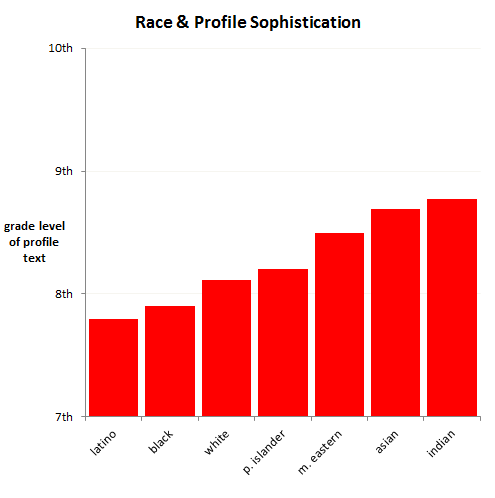
The post goes into some even more delicate areas when they decided to run a reading-level analysis.  Using the Coleman-Liau Index, they analyzed user profiles and then separated them by race.  OkCupid's Profile Reading Level by Race
And then they went back and compared against religion. That graph squares nicely with the racially-based one if you consider the dominant religions in the racial categories. Atheism and agnosticism have been linked with higher education levels, too. OkCupid Profiles' Reading Level By Religion

But let’s back up for a second here and note that none of the profiles rate above the 9th grade reading level.  The Cloeman-Liau index only looks at the length of words by character (as opposed to syllables) and the length of sentences in words. For the casual nature of an online profile, this benchmark probably doesn’t accurately reflect intelligence,education level or, well, anything.

I find it unusual and refreshing that the site is making this information public on their blog rather than trolling through it looking for marketing angles. It is also brave of them to discuss the often delicate subject of differences among races. It’s a little baffling why they would choose to do blog about racial distinctions, but I suppose that this being a “random”, and therefore presumably unbiased, collection of statistics protects them from charges of racism.  Well, that and the  fact that we’re talking about an online dating site’s users whose self-applied labels are known to be of dubious veracity and statistically unreliable for the population as a whole. OkCupid’s blog posts consistently get attention (people want to read “insider information” on online dating, it seems) and this semi-controversial subject garnered a good deal of pageviews and blog mentions. Perhaps the motivation for this post isn’t so hard to discern; it’s a buzz generator.

I just posted an article on Examiner.com about Operation HOPE, a nonprofit working for economic justice by facilitating private businesses to operate in under-served communities. At least, that’s what I think they do.

As I was researching my article, I kept running up against a lack of clear brand identity and sub-optimal web design. Let’s look at the identity issue first. Take a look at Operation HOPE’s About Us page and tell me what they are, what they do or how they work towards their mission. Having trouble? I know that I did.

Under History and Mission we can see their mission statement pretty clearly: “to eradicate poverty in our lifetime through the ‘Silver Rights Movement'” We can tell right off the bat that they are an anti-poverty organization. That’s good. So, what exactly is the “Silver Rights Movement”? One might think that a definition or description could be found by following History and Mission link. But,no. Instead, the visitor gets a small paragraph with three defining statements. Operation HOPE, Inc. (HOPE) is:

  • a non-profit, public benefit organization…
  • America’s leading provider of economic tools and services
  • an effective facilitator, lender, advocate and educator…

No mention of Silver Rights is made (and won’t be made for the rest of the page). The claim to be the “leading provider of economic tools and services” is entirely unbelievable without a qualifier.  Are we to believe that HOPE really provides more economic tools and services than Fannie Mae, the SBA, Bank of America, Citigroup, Western Union or PayPal? I’m sure there is some niche or collection of tools and service for which HOPE is the leading provider, but I can’t believe that they are number 1 in the country (notice it’s not “one of America’s leading …”).

The third statement is helpful and seems to define their role, although not very narrowly.  It is a complex organization that is working on many fronts, so we can forgive them for that.  However, the statement ends with the opaque term “the other America.” It isn’t until the third paragraph that the reader sees another mention of “the other America” and there’s no definition of the phrase until the end of that paragraph. Worse still, the paragraph in between is a dense brick of text with sentences that sum up to; What we do, some part of our mission, redux of last sentence, somewhat paradoxical, different mission component, data-poor marketing statement.

If we wade through all of that and get to the bottom, we still don’t have a clear picture of their mission or history.  The closing paragraph has more overlapping or contradicting mission statements; “HOPE’s mission is empowerment. [aha! Thank you! Shoulda been bullet point #1. Now, for whom, how, when, why?] The objective of HOPE’s work is …” No one should be expected to wade through all of this text to find the core idea, especially on the web.  Then, they end with what could be a wonderful mission statement that could be a list with links to each item at the top of the page. Overlooking the typo there, the last sentence still ends with a clunk.  Bridge what gap?

I find this really disappointing for an organization that is doing such important work.  They are hamstringing themselves by being abstruse.  I have worked for nonprofits with varied programs and complex identities before. I know that it can be difficult to distill the essence of the whole while accurately including the many varied parts. Operation HOPE’s website is an especially unfortunate and acute case of ill-defined (or poorly expressed) identity. There’s no simple statement of who they are, what they do and how they do it.  There’s not even an elevator pitch encapsulating their identity in a paragraph or two.

The design of their sites, and there are multiple ones for their projects, also contributes to the obfuscation of their greatness.  The navigation bar on the left is not ugly, but it pushes important, attention-getting buttons way down below the fold.  Each item expands in to several subheadings, but how is anyone supposed to know which of those they are interested in prima facie? It would work much better to have the links we can see now under categories. “About Us” would contain the info about the chairman and the global spokesman. “Programs” would include all of their initiatives listed there, at least one of which is actually volunteer outreach, i.e. “Get Involved.” And so on.

The site is in serious need of updating as well.  The most recent annual report is from 2007! The initiatives page (not the Global Initiatives, mind you) doesn’t include the 5 Million Kids initiative that gets its own banner on the front page. All of this continues the pattern of enticing the visitor in, “Learn More”, then falling short on delivering the goods.

Spreading the different components of the organization across multiple websites is a risky move, too.  The 5 million Kids Initiative (which is laudable) has its website featured prominently on HOPE’s main page, but it isn’t easy to get from 5MK back to HOPE.  The 5MK site’s slicker design might make someone not want to leave it anyway.  It has an abundance of information, but it’s clearer and more colorful. Then there’s a MyOperationHOPE site, which seems like a much cleaner design of the main site, to encourage personal participation.  It is much more intelligible and has some clearly defined channels for supporters to get involved. However, it contains so much of the original site, it ends up fracturing social involvement rather than integrating it.  (Looking for the social network tie-in on the main site? It’s a small button all the way down in the footer.) The lack of clarity extends to John Hope Bryant’s site, another offshoot of OH.org, too. I think they should work on integrating the multiple sites into as few as possible, present a clear relationship between them and make it easy to get from one to the other.

Operation HOPE is a remarkable success story in the nonprofit world and a leading innovator in combating the causes of inner-city poverty.  Mr. Bryant, who founded Operation HOPE, has visionary ideas.  He’s published books and served on presidential advisory boards.  They both deserve better marketing than they are getting with these websites. The lack of clarity and poorly expressed messages do a great disservice to the remarkable achievements and groundbreaking work of HOPE, making it hard for even their supporters to support them.

The main use of the web for nonprofits should be to facilitate public support.  It should make it easy for someone to give a donation and be compelling enough to convince them to do so. This doesn’t require cutting edge design, but it does need serious consideration given to design.  It doesn’t require great writing even, but careful editing. Websites should lead visitors from the hazy to the specific, converting casual readers into supporters as they learn more and more about an organization’s positive attributes. Failure to do so puts any organization at a real disadvantage in the competitive market for funding or revenue.
This weekend, I met a local San Francisco painter whose time at Cal overlapped with my own. What’s more, he knew some of the same people I had known in the co-ops. Because of these connections and the fact that we only knew our respective companions at the BBQ we attended, we ended up hitting it off.

Later that evening, he showed his studio to our little crew. On the walls, in various stages of completeness, were his wave paintings, for which he is somewhat renowned. I think they are an interesting abstraction born out of the representational. He works from photographs (that are clearly representational) and accentuates, tweaks and otherwise plays with the colors and forms to get the feeling that he wants. (Two of my readers might also be interested in these paintings from his earlier, non-wave works.)

As much as I appreciated seeing his work, especially within the work environment whence it develops, one of the coolest parts of the evening was when he took down a book of the paintings of Neo Rauch. Rauch’s paintings are amazing; bold, carefully chosen colors highlight strange figures in landscapes or spaces that are paradoxical and shifting. You can see 45 of Rauch’s paintings here, although none of these were in the collection that I saw. Paintings 6 through 8 in that link show some of what I mean about Rauch’s playing with space. The dimensions all make sense if you look at each little area, but then they seem to shift and flow into one another; a slightly more unnerving M.C. Escher illusion.

I found Rauch’s paintings to be surreal in the best possible sense of the word. They aren’t strange just to seem strange, nor are they morbid or simply disgusting, the way the work of some contemporary painters who have taken up the surrealist label can be. Rather, the paintings seem to use the quotidian, and our own conceptions of what constitutes the normal world, to undermine that same, somewhat smug, understanding. Rauch manages to do all of this while using and combining colors that are just beautiful to the eye. I’ve always found that the palettes of the early Surrealists were just too drab for my liking.

I really have to applaud Federal Judge Vaughn Walker on his jurisprudence in declaring Proposition 8 unconstitutional. Judge Walker looked at whether Prop. 8 violates the Due Process (the government can’t deprive people of life, liberty or property without) and Equal Protection clauses of the 14th Amendment. (Which, to same, I say Happy belated Birthday.) And, based on Reason rather than sentiment or belief, he found that there is no justification to deny these rights to gay men and lesbians.

Prop 8 supporters immediately decried this Reagan-nominated, Bush Senior-appointed justice as being one of those “activist judges” because he found there to be no good reason put forth to justify denying rights to this group of people. I have to think this is the inevitable conclusion because what rational, non-homophobic justification is there for discriminating against homosexuals?

Walker took pains to point out that marriage is a civil matter which religious leaders only “solemnize”. That view effectively cuts off any rebuttal based on religious tradition. More than that, it also recognizes that religious institutions, if they want to, can go ahead and discriminate. Rastafarians can refuse to recognize or perform the wedding of two battyboys (their repugnant term, not mine), but that has no effect on the couple’s ability to enter the legal agreement that is marriage. I hope, somewhat irrationally, that this will help the religiously bigoted deal with the fact of the matter.

This is a great moment for the triumph of reason over people’s baser beliefs and hateful dogma.

My title is not quite as pithy as Louis XIV’s dictum, but nonetheless, I have been officially named the LA Poverty Examiner on Examiner.com. I’ll be writing there on the issue of poverty as it affects the Los Angeles region. Among the topics I’ll be looking at are the intersection of poverty and immigration, the City’s response to the needs of the poor, national-level legislation with local impact and the efforts of Angelenos to combat the worst forms of poverty.

If you have any ideas for stories or topics that you think deserve attention and fall into that rubric, please get in touch. In the meanwhile, check back on that Examiner.com page for the latest on poverty issues from an L.A. perspective.