Archives for posts with tag: poverty

National Geographic has an excellent article online called “Necessary Angels” about a program in India called Jamkhed that is training community health workers. The health workers live in villages where there is little or no other medical care available. They focus on preventative treatment since the great portion of maladies that afflict the poor in these villages are preventable. Interestingly, the article explores the opinion of several people who say that doctors are not the answer because they earn their money off treating, rather than preventing, disease.

Furthermore, this indigenous program, which was started by Raj and Mabelle Arole, has taken on a radical social change experiment. The village health workers that are trained are all members of the “untouchable” caste. The caste system is officially banned in India, but continues to thrive in rural villages. By placing “untouchables” in positions of authority, Jamkhed has turned the social paradigm on its head. The women from the “untouchable” caste gain confidence and the demonstration of their efficacy breaks down the superstitious and stupid social mores.

There’s an interesting point made about the growth of this program. In 38 years of existence, they have trained health workers in 300 villages. That figure shocked me because of how few villages they have reached in such a long time. Contrast that with a program like BRAC, which is mentioned in the article and has been around for a similar amount of time. BRAC has set up “essentially a substitute for a government health care system, with 70,000 village health workers in 70,000 villages.” The response from Jamkhed as to why it has not scaled up is that they have expanded to include other services beyond health. That argument simply does not hold water in the face of BRAC’s success at providing health care, education, housing and financial services. It sounds to me like Jamkhed is lacking either the will from management or a sustainable model to allow them to scale.

Accompanying the article there is, as you would expect from National Geographic, a wonderful photo gallery as well as other supplementary material.

The poorly named, but nonetheless worthwhile Free Poverty website is similar to Free Rice.  The difference is that the game at Free Poverty is not based on vocabulary, but rather knowledge of world geography.  It’s very similar to the Traveler IQ game that was popular on Facebook a little while ago.  They also don’t donate rice, but water.  Try it out.  A word of warning: Don’t try to click and drag the map.  The focus of the map will shift automatically to include the place you’re looking for.   I lost two lives right off the bat because of that.  I blame Google for making me think that every map can be manipulated.

As a dedicated poverty fighter I couldn’t resist participating in this year’s Blog Action Day.  I have joined the swelling ranks of bloggers (over 12,000 and counting) who are using their collective influence to bring attention to the issue of poverty.

Here’s some more on the history of Blog Action Day.  The proceeds from today’s activities will be sent either to Kiva or the Global Fund to Fight AIDS, Tuberculosis and Malaria.

These are both laudable causes.  I’ve been lucky enough to have met staff members of both organizations through my work with the Microcredit Summit Campaign (and their shared office with RESULTS which works to support the GFATM).  I’m also a lender on Kiva and, in fact, have some funds that have been paid back to re-loan. If you haven’t had the pleasure of setting up an account on Kiva and contributing, I highly suggest you check it out.  Even in today’s uncertain economic environment, there is something fulfilling about giving money away to a greater cause. It reminds you that you are relatively rich.

And you are relatively rich.  There are a billion people living on a dollar a day or less, and nearly half the world’s population lives on $2.50 per day or less.  Those are staggering and appalling figures.  It really puts things in perspective

There is a ray of hope for those teeming masses of humanity whose faces we don’t get to see or and whose voices we don’t get to hear.  There is an army of people working tirelessly and often thanklessly to serve the needs of the very poor.  It is a long, hard road, but some very dedicated, intelligent and good-hearted people are committed to overcoming the challenge.  In recent years it seems like there has been a noticeable increase in the attention that world poverty and hunger get in our society.  Maybe it took Bono and Brangelina getting into the act before we took notice, but the momentum is growing.  (I can’t say if and for how long that trend will continue.)

The world’s poorest citizens are facing a number of ominous threats; the hunger crisis, financial meltdown and climate change.  Fortunately, we have a good idea of how to combat all of these.  Organizations like the Microcredit Summit Campaign, the Earth Institute, the We Campaign and Freedom from Hunger are developing and promoting the innovative, yet proven solutions to many of these problems.

On this day of action, i hope you’ll take a moment to consider how incredibly fortunate you are and to think about the great majority of the world who want need the tiniest portion of that luck.

Freedom from Hunger Day 2008 - Sept. 25 to 28

Freedom from Hunger Day 2008 - Sept. 25 to 28

In the midst of all the clamor surrounding the U.S. presidential election, the usual political machinations of world powers and the tantalizing suspense of reality TV contest shows, it’s easy to forget that there is a dramatic and calamitous crisis occurring right now that threatens to push 100 million more people into the grip of chronic hunger and poverty.

The Global Food Crisis, in which food prices has soared out of the realm of affordability for hundreds of thousands of people, has been described as a perfect storm and a “silent tsunami,” but there is an important difference between it and those two analogies.  The Global Food Crisis, while certainly multifacotrial, is at least partly caused by humans.  If we can break it, we can fix it.  With the fate of literally millions in the balance, it is imperative that we do so.

This weekend marks Freedom from Hunger Day, an officially recognized observance of the worrisome level of poverty in the world and the laudable efforts of those who are combating it.   I feel like this time is also an opportunity for us to pause for a moment to think about the current situation in the world.   In comparison to the petty annoyances of daily life, it is sobering to imagine the lives of the 2 billion people that lives on less than $2 a day and all those in peril of slipping down into extreme poverty and chronic hunger. Freedom from Hunger Day provides an easy way to learn more about the situation and a way to take a positive action to help those in need.

Freedom from Hunger, the organization I recently started working at, has been fighting to eradicate chronic hunger for over 60 years.  I think that their interventions have become all the more crucial in the face of this crisis.  The president of Freedom from Hunger, Dr. Chris Dunford, has written cogently on the situation.  Freedom from Hunger has reached over a million women with their lifesaving programs that allow families to sustainably help themselves out of poverty.  Their most powerful and proven weapon so far has been the Credit with Education model which they pioneered some twenty years ago.  As an organization that constantly seeks to innovate and to reach further with those innovations, Freedom from Hunger has developed a number of other programs that are now bringing a chance for a healthy, productive lives to poor women around the globe.

I urge you to visit Freedom from Hunger in the coming days and participate in Freedom from Hunger Day.  If you have comments about the Global Hunger Crisis or Freedom from Hunger, I’d welcome starting a conversation here.

Free Rice

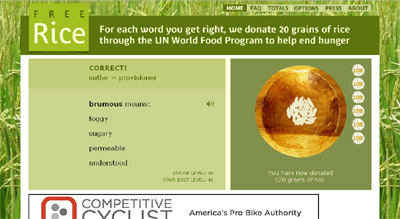
A few of my friends have recommended a game called Free Rice. I finally played it for the first time yesterday and I’m completely sold. It’s a free vocabulary building game with a simple, yet powerful catch: every correctly answered question earns grains of rice to be distributed through the World Food Program. They say that it’s set up to actually increase the player’s vocabulary. Each correct answer will also (in addition to the rice that is) get you a harder word on the next question.

They aren’t kidding around with these words either. They start out in 12th grade English class territory and quickly move to Hal Incandenza level. I had a good roll for a while, sometimes getting by on dumb luck and sometimes making educated guesses based on Greek, Latin or French etymologies. (They seem to use a lot of words derived from the French. I mean, hebdomadally? C’mon.)

My efforts were definitely helped by my subscription to “A Word A Day,” a very nicely done daily vocabulary email that I’ve been reading for a couple of years. Strangely, I was also helped by my knowledge of medieval arms and armor; on multiple questions.

Yesterday, I earned over 3,000 grains of rice and got up to “Vocabulary Level” 50, also known as Sesquipedalian-5. So, folks, how many grains can you earn today? Go try and tell me how you do in the comments.

By the way, you can play as much as you want. Bookmark it and come back every day! You can also have it remember your vocab level and donated rice; look under “options.”