Archives for posts with tag: jamii bora

After spending two months in Kenya during the run-up to their presidential elections, I was greatly saddened and shocked to hear of the eruption of violence that has wracked the country. I am saddened not only by the rising death toll and numbers of displaced families, which are tragic, but also by the loss of the promise that Kenya held as a model, healthy society.

Photo by Gabriel Kadidi.The situation in the Kibera slum of Nairobi

The Kenyans that I met during my time there told me that they knew that there would be problems with the election. Some of them expected “irregularities” in the vote tallies, some even worried that incidents of violence would occur. Although they were all aware of tribal differences within the country, no one imagined that such awful strife would erupt. Sadly, I think we must attribute a large portion of the blame to people in positions of power who are manipulating the public in their struggle for even greater riches. Do not blame the peasants who are both committing acts of violence and suffering from them; they are merely pawns to the political elite who have held power in Kenya for years. This election and the engineered unrest that followed are all about a chess game played by the upper class to increase their piece of the pie. I don’t blame the poor, the ones who are suffering most in this situation, for being “racist”, “tribal” or inherently violent. Rather, I am disheartened that the most vulnerable have been taken advantage of.

Upon hearing the news of the unrest, and subsequently following the story as best I can through the media, my heart was gripped by the desire to help. I am thinking not only of the many good people that I worked with, sang and laughed with and said goodbye to in Nairobi, but all the Kenyans out there who looked forward proudly to a brighter future. For a while I felt there was nothing I could do. A story came on NPR about donating phone credit to people who have been displaced in these clashes, but the website mentioned didn’t work for me. Then I discovered that Jamii Bora, the microfinance institution with which I worked in Kenya, has set up an emergency fund to provide help to those affected by the unrest.

Jamii Bora, which works to create “better families” as it’s name suggests, is continuing to work with the poorest Kenyans to help improve their lives. The members of Jamii Bora live in the slums and the rural areas of Kenya and, with access to microcredit and health services provided by Jamii Bora, they had been climbing their own way out of poverty. In light of the tremendous setbacks that they are now facing, Jamii Bora started this fund to begin to help people get back on their feet and to survive these dark days. They are using the money to rebuild their looted offices and to help their members open up their businesses again and return to their homes. The donations will be handled through Unitus, a “global microfinance accelerator” and Jamii Bora partner based in Seattle, Washington.

Click here to donate to Jamii Bora’s Emergency Fund.

Below is a message from Ingrid Munro, Managing Trustee of Jamii Bora, highlighting the seriousness of the situation and asking for assistance.

Dear friends,

We have been able to be in touch with most of our branch staff in various parts of the country. The situation is very serious in many parts of the country. The target for most mob actions are the Kikuyu, the country’s largest tribe. But even families of other ethnic background are victims when the looting goes out of hand and nobody has time to check who is a Kikuyu and who is not.

Jamii Bora members are particularly badly hit, first because they are in the poorest areas that are most badly affected, second because in these areas they are often the most successful business people after many years of climbing with Jamii Bora, third because many are Kikuyus in the central urban areas, fourth because the police protection is not so strong in the poorest sections of the cities and town. The areas of the rich are much better protected and hardly attacked at all.

Terrible things are happening. People are killed and injured. Rape is on the rise. A church where many families with children had sought refuge was burnt down by an angry mob in Eldoret and many people including at least 34 children were killed. Poor people’s businesses are destroyed, burnt and/or looted. Homes and even churches are burnt down. The fruits of their hard work to climb out of poverty has been destroyed and burnt to the ground.

Tense calm has returned to a few places but most of the badly hit areas are still experiencing problems. Many families are running away in panic and have lost everything they have worked so hard for.

Some of the worst hit areas are the large slums in Nairobi especially Kibera, Mathare, Huruma- Korogocho, Kangemi and Kawangware. Other towns that have been exposed to serious destruction are Eldoret, Kisumu, Kericho and Mombasa. Many other parts of the country are experiencing serious problems in poorer sections of the towns. Several of our branches have also been looted and our computers and POS machines stolen. People can not run their businesses for risk of looting, thus even those who have not been looted or burnt down are affected. No buses are available since the owners fear that they may be stoned or vandalized. People are starving because they cannot access food, they are homeless and seek refuge at police stations and churches. Thus everyone is affected.

Jamii Bora estimates that almost 50% of the members are affected in at least one of the above mentioned ways. Our own disaster fund will not last long in this situation and we urgently need help.

Anything you can do to assist and contribute in a big or a small way will be highly appreciated.

Warm regards

Ingrid

If you can help, please click here to make a contribution through the Unitus website.

I thank you in advance and ask that you not give up hope for the good people of Kenya.
Me and a cobbler in the Mathare slum
-Trenton

Kaputei
Kiambu Kaputei 168Kiambu Kaputei 167
In recognition of the deplorable living conditions in the slums, Jamii Bora decided to create high-quality, low-cost housing for its members. This simple idea has spawned the creation of an entire town. Some 2,000 houses surrounding commercial and community centers will be built in Kajiado District. The town is to be called Kaputei, after a Maasai place name. The houses will be financed and sold only to Jamii Bora members. Already there is a long waiting list for these houses with priority being given to those members living in the slums of Nairobi.

The houses are built from cinderblocks and are roofed with red clay tiles. Both of those materials are made on site, providing employment in the area already and saving money on transportation of supplies.

Kiambu Kaputei 126Another brilliant component of the project is the two constructed wetlands that will treat non-sewage wastewater (greywater). These are very advanced applications of an extremely cost-effective technology. The wetlands component will be done in conjunction with teams from two of the top universities in Kenya. The semi-arid land in Kaputei makes water management and conservation a necessity.

The project faced opposition from various groups, but has finally been given clearence by the courts. The construction phase has started and over 200 homes have been completed by the time of this writing. The pipe dream has become a reality.

Two weeks ago I finally got the chance to see the site where this town is coming into being. I drove out with the two Swedish guys. We drove for a while outside of Nairobi through brush- and grassland. The town site is actually well over an hour away from Nairobi, a fact which causes some concern among people who hear of it. How will being so far outside of Nairobi affect people who have businesses in the city?

I’m not sure that anyone can accurately answer this question. However, the members are all dying to get out of the slum. They’re also resilient entrepreneurs. i’ve heard from a few that they will simply try another business there, filling in the niches of demand. With 2,000 families living there, a sizable market will exist.

Kiambu Kaputei 077We started the visit in the temporary factory where the blocks and roofing tiles are made. Teams of people mix together the components of each and use a mechanical shaking device that homogenizes the material within the molds. They have been doing this for several years now and the stock of materials that they have lying in wait is impressive.

Some container architecture
From the factory we went briefly to the site office where the site managers were showing us the plans. This building is made from two cargo containers. They have been placed about six feet apart with their longer sides parallel. The entire space was then roofed. It made for a nice little office and with some tweaks could easily become a home.

From there we went on to the site of the already constructed houses. It was amazing to see them with my own eyes. It is easy to see why some Jamii Bora members are skeptical that the houses are being built at all. They look like they could be a development in Southern California. The houses are in neat rows, all of them free-standing, with their red tile roofs. Even knowing that there are only 250 or so built, there are a lot of them.

Kiambu Kaputei 175We were visiting the site with Wilson Maina. He lives in Mathare valley and was the one who showed me around that slum. He is also going to be one of the first residents of Kaputei. We were looking at his future home. He is very excited about the prospects and anxious to see the project completed. They are going to have people start to move in as soon as the services are in place; before all of the 2000 homes are built.

The house that we looked at was a two bedroom. It is a good size with the bedrooms on one side, the kitchen and living/dining room on the other and the bathroom in the middle across from the front door. It is much bigger and much nicer than the fire-prone single room that Wilson and his family currently live in.

I have become as anxious as the Jamii Bora members to see the project completed. It is an awesome undertaking that is actually coming to fruition. When it does it will be a great boon to the members. They have climbed out of poverty and soon they will climb out of the slums.

The Kitengela boys home and a little safari
On our way back we stopped at the boys home in Kitengela. We chatted with one of the men who looks after the boys. There are two adults who live there and look after some 70 kids. A good number of those are older and are away at school now, so the numbers are much more manageable.

When we arrived the boys were still at school. So we drove out by their school and decided to wait for them. While waiting though our driver, Wycliff, drove us down a dirt road that peeled away from the main road. All of a sudden we were on safari.

We saw zebras and some gazelles first off. Then we started seeing the giraffes. There was a herd of them meandering through. We were all pretty excited. The Swedish guys and I were busy trying to take pictures. Wilson, who was seeing live giraffes for the first time, was ecstatic.

At one point the van was approached very closely by a bull giraffe. Wilson got out and waved his jacket around just to see the reaction of the animal. It moved away towards the rest of the herd. Wilson said, “Imagine me, scaring a big animal like that!” We were all smiles. The Swedish photographer, Casper, printed out the photos from that day when we returned to the office. They were enjoyed by all, especially Wilson who took his home to show his son.

After our excitement with the giraffes we went back to the boy’s home where the children had now returned. The boys were cleaning up after their day at school. There was much industry and excitement among them. They were more than happy to show us around and to share their stories. They are all orphans or former street boys. I know they must have problems, but they were all so happy to show us the bunks they slept in and the small desks they studied at. They were like a huge family of brothers.

We spoke to the kids for some while and they even sang for us. Then it was back in the van for a traffic-lengthened trip back to Nairobi. Once back I went to the hostel of Per and Casper where we hada few Tuskers and shot some pool on the warped felt of the table at the Nairobi Bacpacker’s Hostel. That place was nice enough, laid-back with an outdoor fireplace, but I wasn’t convinced I’d want to stay.

All in all, it was a very nice day.

Day two in Nairobi started off nicely with a peanut butter and banana sandwich. I also had taro root, served boiled and washed down with my coffee. It is very dry in one’s mouth, like a boiled potato without garnish of any kind, and it has a faint taste of tapioca. It’s not unpleasant, but I can’t say that I was thrilled to hear that it is a staple for breakfast.

Jamii Bora had an important meeting this morning with the Central Bank of Kenya. We stopped on the way in to pick up a World Bank researcher from the Fairview hotel. This is one of the nicer hotels around and is very safe since it is located next to the Israeli embassy. That place is like a bunker and, in fact, the public road outside has these “friendly roadblocks” around which drivers have to swerve.

The woman from the World Bank was greeted with singing as I was yesterday and I got swept up in the process. This time I didn’t hesitate to start clapping along. Singing is a whole other story.  I think the words are the three slogans of Jamii Bora Kwa Mokao Bora, Kwa Afya Bora and Kwa Maisha Bora (making housing better, making health better and making life better), but I can’t really tell. I need some lessons.

Getting swept away by this tide of hospitality brought me face to face with Ingrid Munro for the first time since my arrival. We shook hands and we said a quick hello, but the singing still continued. I wasn’t supposed to be in this meeting, so I ducked out shortly after for a tour of the branch office downstairs. I would see Ingrid again later that morning and she asked if I were settling in all right.

Ingrid Munro
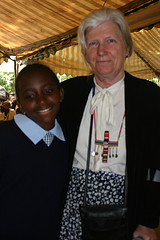
Ingrid Munro and a schoolgirl
Ingrid is more than just a pioneer in the field of microfinance. She is a woman full of love. She had been working with the African Housing Fund while at the same time helping out some women who were beggars in the street. She came to realize that she could never sustain them all forever; charity could not change their lives in the end, only offer a temporary respite from discomfort. When she told them that she could not go on, these beggar women told her that she could not simply give up on them, So, she started with an idea that for every shilling they could save, she would find someone who would give them two.

Thanks to some early benefactors, the plan succeeded. Soon, Ingrid progressed to a more regular form of microfinance. Thus, Jamii Bora was born and began to grow. Since then she has strived to find ways to make the program have a lasting effect on the members. As an architect by training she has naturally come to focus on suitable housing for the members. From this has come the Kaputei town project, a 293-acre housing development strictly for Jamii Bora members.

In addition to the microcredit and all of those side programs that I mentioned in yesterday’s post, the main difference between Jamii Bora and other MFIs that I know of is that it is based on the idea of a family. This family is composed of all the members of Jamii Bora and Ingrid is their mother.

She has fought for them as a mother would. She has worked tirelessly to not simply sustain them, but to prepare them to be self-sustaining. I think that is why she is truly like a mother, because she knows that her children must leave her at some point, and she wants them to be ready. She expects nothing but the best from her staff and the members of Jamii Bora. Because of this, she often gets remarkable results.

From what I have seen, she strikes me as a very determined woman. She speaks often about not accepting excuses. I have seen a video where she says that she sometimes worries that she cannot help and I think this is what keeps her resolute.

Matatus

One quintessential experience in Kenya, and especially Nairobi, are the mini-buses known as matatus racing around full of people. A helper jumps out collects people and with two bangs on the frame, hops back in, bills folded between his fingers. There’s a code so that the driver knows when to stop and when to takeoff again. Inside, blaring music and mismatched decorations. Today it was stickers that said things like, Problems are part of life. Some have music blaring with lyrics that speak to the common man. Lyrics like, “life is serious, cantankerous and dangerous.” (wait, life is grumpy?) The drivers, who have no timetable to keep, race around like madmen. They vie for positions in roundabouts and wedge themselves between trucks and go over sidewalks. (well, there aren’t really sidewalks, just packed dirt by the roadside

It is neither comfortable nor safe. Recently they have been cracking down on them, however. So, the days of chickens and goats inside the matatu are seemingly over. Even overcrowding is kept to a minimum. Unfortunately, though, Nairobi is facing a real crisis in terms of transportation. There are not enough roads to support the number of cars and the number of cars isn’t sufficient for the number of people who need them. Public transportaiton is the only answer. If ever a city needed a light rail, it’s Nairobi.

I have seen people riding bicycles, but I think, due to the great danger posed by the road traffic, most people are too scared to ride one around. I have heard, however, that one form of microbusiness is to buy a bicycle and cycle people from place to place like a taxi, which I thought was rather cool.

Yesterday was my first day in Kenya-
I arrived early in the morning on a Virgin Atlantic flight that was notable only for the stringent, repeated seatbelt checks.

Dalia remarked that Nairobi’s Jomo Kenyatta is much bigger than the airport in Lome, Togo. Go figure.
After picking up my bag, I stepped out to the waiting crowds and easily spotted Susan wearing her Jamii Bora t-shirt. Jamii Bora is the name of the microfinance institution that I am volunteering for. It means “good families” in Swahili. We took off towards her house in the taxi of Alex, a Jamii Bora member. The cool of the morning was being burned away by the sun as we negotiated the road. I had just read that arriving into Mombassa and leaving the airport was quite a culture shock. Arriving in Nairobi is not. There were large numbers of people walking up and down the streets, on their way to work in the industrial area. Matatus, buses, cars and motorcycles all jockeyed for position while avoiding crossing pedestrians. Other than that, though, it was nothing too extraordinary. We ran into traffic, which is infamous in Nairobi. Every car ride I’ve taken so far has turned excruciatingly long because of traffic jams.

Susan and I exchanged small talk about my flight, my country, my motives for coming out and the operations of Jamii Bora.

We finally arrived to her apartment in the Emily Flats complex. It is somewhat west and south of the city’s center. She had warned me that she lives a middle-class life and that her apartment therefore wasn’t much to brag about. However, I have a large room with a bathroom all to myself and the whole apartment seems like the sort of thing that I’ve seen plenty of in Spain. The apartment I shared with friends on summer in Tarifa is comparable (although there’s no pristine beach five minutes away from here).

A nice breakfast was laid out on the table for me. It included both the very British Weetabix and the very American peanut butter and jelly. (Peanut butter not entirely American, you say? It was Skippy.) They are spoiling me with food, I think.

I was more tired than I thought due to the aforementioned seatbelt checks. Susan suggested that I rest a bit and I followed her advice.
I took a shower (well, the shower’s busted actually. so, it was more like pouring water from a basin over myself. Very hot water, though.) and slept for two hours.

We ate some lunch and went over to the Jamii Bora headquarters. It is a large building in the industrail area that they have recently acquired and set up as the main office. It is bright white and spacious inside. In another place it could be a hip loft space.

I was greeted with singing by the staff members (and members) of Jamii Bora. They lead me up to the conference room for a briefing. After a short introduction, I heard the stories of staff members and the clients.

I have to say that the stories that the clients tell about their lives are so heart-wrenching and beautiful. They have faced innumerable hardships – mafias, fires, HIV/AIDS, tribal conflict – and yet they all end by saying that God is Good because now they are happy, now they look towards the future with hope.

I will be writing up a lot of information that they want to be on their website, so perhaps you will be able to read these stories there. If not, here is a link to a video of Ingrid Munro (the boss around here) presenting these same stories at the Global Microcredit Summit in Halifax. I met Wilson, Beatrice, Clarice and Shosho; they are all mentioned in that presentation.

I also met the heads of several different divisions within Jamii Bora. As a microfinance organization, what makes them so unique is that they treat the problem of poverty holistically. And they get the job done. They started giving out loans until they realized that many members were not paying back those loans because they were getting ill. So, they started a microinsurance scheme that now has hospitals coming to them asking to be their partners. They could see that there were problems with drug and alcohol addiction so they started a counseling division. Knowing firsthand that the slums where the bulk of their clients live are pathetic and inexcusably bad, they started building their own town.

The last I had heard of this town, from the presentation in Halifax, was that it had been stalled by complaints from landowners in the area. However, I was thrilled to find out that all the legal battles had been won by Jamii Bora and construction was nearing completion on the first batch of homes. This town sounds amazing; it will have garbage and recycling services, a wetlands to treat greywater and every home comes with multiple rooms and a flush toilet. In a country that I have found has incredily high property prices, these homes are very affordably-priced. I’ll add more details when I see it for myself.

I didn’t have my camera with me, but I promise I’ll post some illustrative pictures soon. Until then, let me end by saying that I am very happy with my decision to come here to Kenya and to work with Jamii Bora. They have welcomed me with open arms and I think I am going to get a lot out of helping this ‘family’ grow.